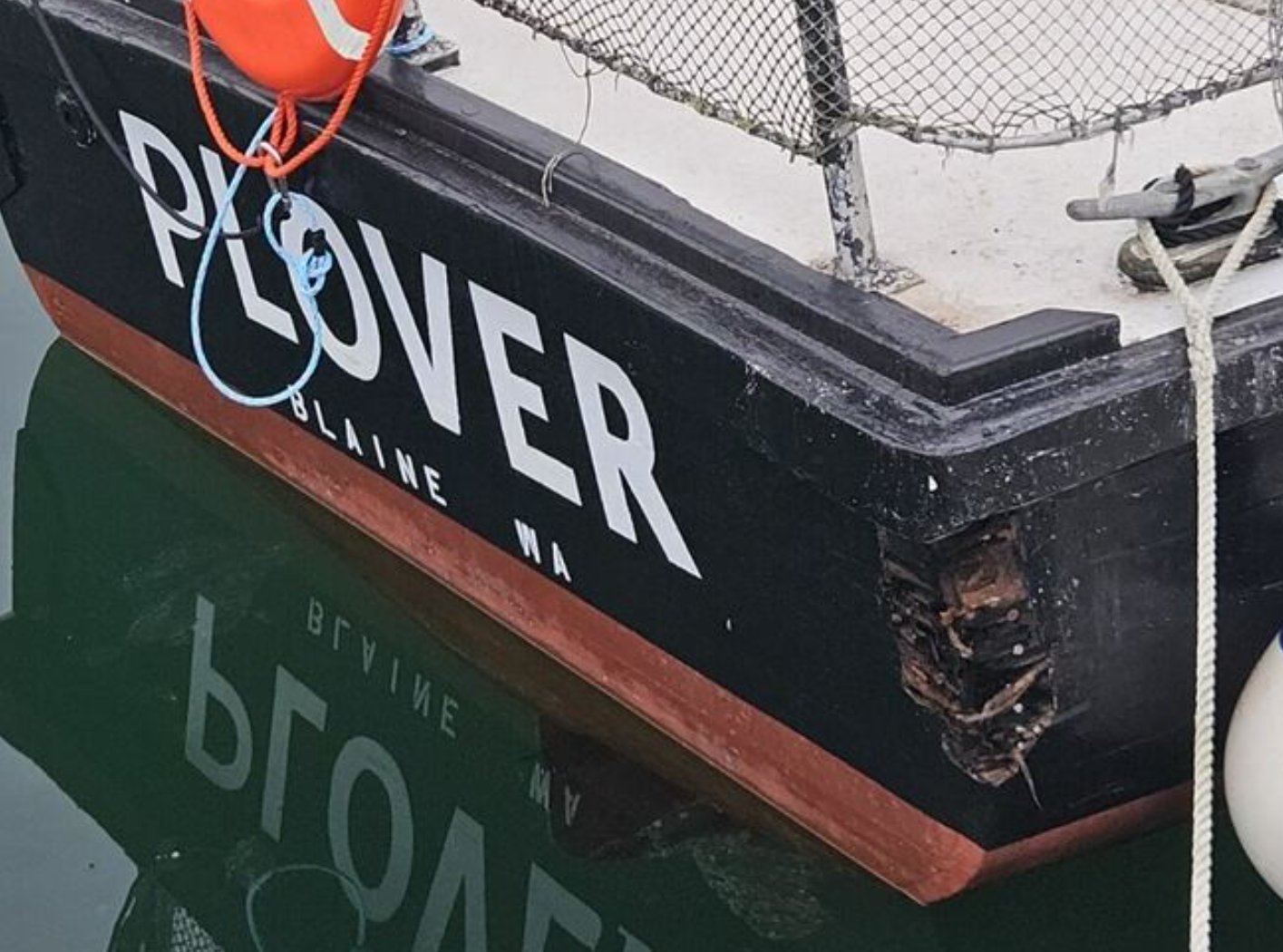
BLAINE, Wash. — The City of Blaine announced today that the passenger ferry, Plover, had received a “No-Sail Order” from the US Coast Guard yesterday, August 28th, following a comprehensive inspection of the vessel’s stern.
The Plover has been out of service since 2022 after significant structural deficiencies were discovered during a bi-annual inspection by US Coast Guard Marine Inspectors.
According to the City, a crew was conducting routine tests and training exercises over the past weekend in preparation for returning the Plover back into service. These activities ended when a section of the Plover’s stern detached, revealing the rotting wood.
As a result, the ferry will remain out of service until the necessary repairs to restore the stern’s structural integrity are completed.
– City of Blaine (August 29, 2024)
Discover more from Whatcom News
Subscribe to get the latest posts sent to your email.
So after allotting $130,000.00 for repair, inspection done by Coast Guard certifying and new over all painting, how could this have gone undetected ? Everyone will be asking this obvious question, not just me.
Dave, thank you for your question. You have taken the points the article wanted to highlight or sensationalize: the $130,000 for repairs. But wait, isn’t the contract for more than just repairs? It is, but no one is talking about that. So, everyone should go back and review what the actual contract covered and stop getting fixated on the $130,000. Also, please review the length of time the money was spent. It isn’t like this was an overnight trip to the store to pick up parts. This is a historic commercial vessel that must meet Coast Guard standards. Despite what some people might say, you don’t just go online and buy a boat like the Plover. The Plover is a tourist attraction that draws people to our downtown and waterfront, helping our local economy grow.
The annual salary of the shipwright is $65,000; I am pretty sure the Plover was not a one-person job. A US Coast Guard Certified Boat Captain, if you are lucky, might be as little as $30,000 (per season). You still need a Seasonal Deckhand to help, and that will run you at least $10,000.00 (per season). It would be a completely different story if these are considered union jobs.
While I don’t have the full story, I can tell you what happens to old wooden boats when they’re taken out of the water for repairs.
When an old wooden boat is taken out of salt water and left exposed to the elements for two years, it quickly begins to degrade in ways that are both visible and hidden beneath the surface. As the wood dries, it shrinks, cracks, and splits, exposing vulnerable seams and joints. The drying process, combined with rain and fluctuating temperatures, creates the perfect environment for rot to set in, often in places not immediately visible. Dry rot, a silent but relentless destroyer, can take hold deep within the wood, spreading unseen and compromising the boat’s structural integrity long before any external signs become apparent. Meanwhile, moisture trapped in shaded or enclosed areas fosters mold and mildew, accelerating the wood’s decay.
The boat’s protective layers of paint and varnish deteriorate rapidly under intense UV exposure, peeling away to reveal the bare wood beneath. Without this protective barrier, the wood weathers and darkens, becoming more susceptible to the effects of water and wind. Once safeguarded by salt water’s preservative properties, metal components corrode quickly in the open air. Rust eats away at fasteners, fittings, and structural elements, making them prone to failure. Galvanized parts lose their coating, and even brass fixtures begin to show signs of oxidation. This hidden corrosion weakens critical components, while ropes, fabrics, and leather exposed to sun and rain stiffen, crack, and deteriorate beyond repair.
Over two years, the combined onslaught of sun, rain, wind, and snow leaves the boat in severe neglect and decay. The visible damage—a weather-beaten hull, rusted metal, and peeling paint—only hints at the more profound, insidious deterioration within. Dry rot may have quietly spread through the wood, undermining the boat’s core strength, while corrosion eats away at essential fittings and fasteners. Without intervention, the vessel that once sailed proudly now sits as a fragile, compromised structure, requiring extensive work to undo the damage caused by time and exposure.
You have taken the points the article wanted to highlight or sensationalize: the $130,000 for repairs. But wait, isn’t the contract for more than just repairs? It is, but no one is talking about that. So, everyone should go back and review what the actual contract covered and stop getting fixated on the $130,000. Also, please review the length of time the money was spent. It isn’t like this was an overnight trip to the store to pick up parts. This is a historic commercial vessel that must meet Coast Guard standards. Despite what some people might say, you don’t just go online and buy a boat like the Plover. The Plover is a tourist attraction that draws people to our downtown and waterfront, helping our local economy grow.
The annual salary of the shipwright is $65,000; I am pretty sure the Plover was not a one-person job. A US Coast Guard Certified Boat Captain, if you are lucky, might be as little as $30,000 (per season). You still need a Seasonal Deckhand to help, and that will run you at least $10,000.00 (per season). It would be a completely different story if these are considered union jobs.
While I don’t have the full story, I can tell you what happens to old wooden boats when they’re taken out of the water for repairs.
When an old wooden boat is taken out of salt water and left exposed to the elements for two years, it quickly begins to degrade in ways that are both visible and hidden beneath the surface. As the wood dries, it shrinks, cracks, and splits, exposing vulnerable seams and joints. The drying process, combined with rain and fluctuating temperatures, creates the perfect environment for rot to set in, often in places not immediately visible. Dry rot, a silent but relentless destroyer, can take hold deep within the wood, spreading unseen and compromising the boat’s structural integrity long before any external signs become apparent. Meanwhile, moisture trapped in shaded or enclosed areas fosters mold and mildew, accelerating the wood’s decay.
The boat’s protective layers of paint and varnish deteriorate rapidly under intense UV exposure, peeling away to reveal the bare wood beneath. Without this protective barrier, the wood weathers and darkens, becoming more susceptible to the effects of water and wind. Once safeguarded by salt water’s preservative properties, metal components corrode quickly in the open air. Rust eats away at fasteners, fittings, and structural elements, making them prone to failure. Galvanized parts lose their coating, and even brass fixtures begin to show signs of oxidation. This hidden corrosion weakens critical components, while ropes, fabrics, and leather exposed to sun and rain stiffen, crack, and deteriorate beyond repair.