
Last night the Ferndale School Board held a special meeting which began with the announcement the meeting was going to “focus on the bond.”
Assistant Superintendent Mark Deebach and Superintendent Linda Quinn delivered a presentation about what the district has done over past years to address and plan for school buildings in need of repair. Highlights of the information provided include,
- A volunteer Facilities Advisory Committee (FAC) was formed in 2009 and continues to meet and advise the board.
- The Ferndale School Board compiled their 10 Beliefs related to Facilities
- A comprehensive facilities assessment of all buildings and building components (e.g. pumps, switches, fans) was done in 2011 resulting in an “inches-thick” binder of information.
- In 2013, the FAC presented a 30-year plan to schedule financing and replacement/renovations for the buildings in need as determined based on information from the 2011 comprehensive facilities assessment.
- In 2013, Mountain View Elementary, the building with the highest maintenance costs, was closed.
Superintendent Quinn said lessons were learned while trying to get a bond approved by voters. She said, after the $125-million bond failed to be approved by voters in 2014, results from surveys and focus groups revealed members of the community thought,
- too much money was being asked for
- they were asking for a blank check since there were insufficient details about what the FHS replacement would include
- they would be tearing down perfectly good buildings
- they were moving too quickly, not providing the community with time to consider the proposal
- there was a lack of trust since the voter-approved 2008 bond had not been used to repair/replace the schools identified in the bond description
Another bond was proposed and communications about it sent to voters in 2015 for an April 2016 special election. But, Quinn explained, the “Plan A” and “Plan B” components with lower costs did more to confuse voters than address their concerns. So it was decided to delay going to the voters a while longer.

Click for more information

Click for more information
Deebach then raised the question of “So, where do we go from here?”
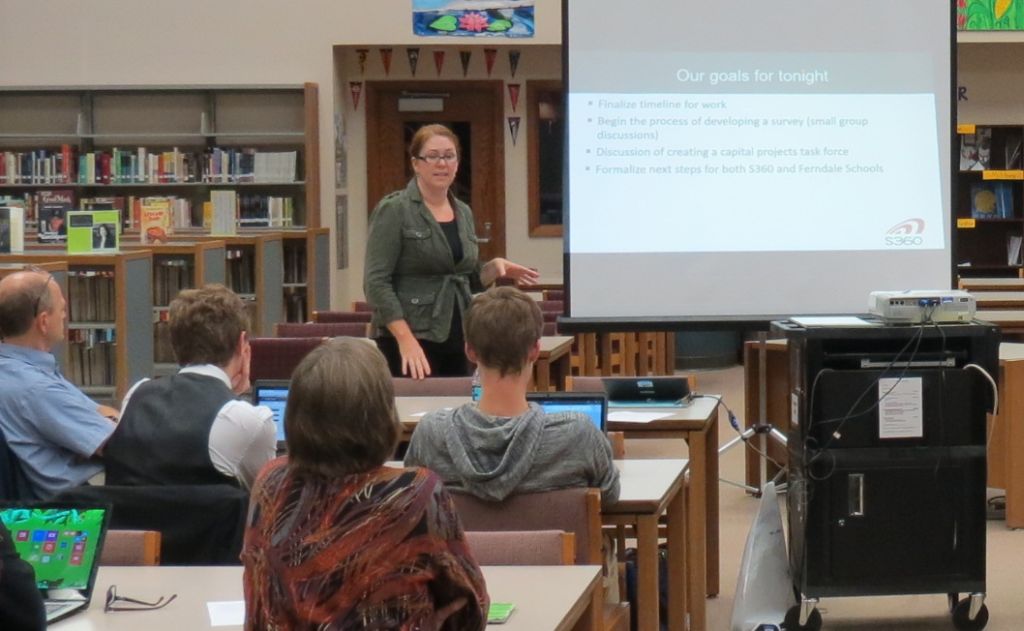
At that point, Lesley Rogers, Senior vice-president of Education at Strategies 360, was introduced to the audience.
Rogers told the audience Strategies 360 has worked with other Washington State school districts in the past to help pass bonds and levies. Included in the list were Lake Washington, Everett Public, Hokinson, Clover Park and Kuna School Districts.
Rogers explained the process they follow typically takes 1 to 1.5 years. She broke it down into three separate steps,
Click for more information

Click for more information
- Gather research and seek feedback from parents, staff and the larger community
- Create a Capital Projects Task Force (20 to 80 members)
- Create a strategic communications and engagement plan
Rogers essentially started the process by getting those in attendance involved about whether to delay the survey and formulation of the task force until after the end of the year to avoid competing with the distractions of the holidays. After a brief discussion, it was the group’s consensus to wait.
The opportunity was also taken to begin assembling topics from the audience to be included in the survey. Several were discussed until the meeting was adjourned at 9pm.
Discover more from Whatcom News
Subscribe to get the latest posts sent to your email.